

Separating Contract and Implementation with Java Modules

#open-source
#support-and-care
#maven
#java
The previous article
showed how to hide implementation details using internal packages.
The core module still mixes two concerns, though: it exports both the domain model (Document, Statistics) and the service implementation (TextAnalyzer).
Consumers that only need the data types must depend on the entire implementation.
Java Modules provide an elegant solution: separate the domain types into their own module and use requires transitive to keep things convenient.
The problem: mixed concerns
After the previous article , the core module looks like this:
module com.openelements.showcases.analyzer.core {
    requires org.apache.logging.log4j;

    exports com.openelements.showcases.analyzer.core.model;
    exports com.openelements.showcases.analyzer.core.service;
}
The module exports both model — domain types — and service — implementation.
Any module that needs Document or Statistics must depend on core and transitively pulls in Log4j and the internal implementation.
This represents a common antipattern in modular design: mixing the contract — what the module promises — with the implementation — how it fulfills that promise.
Introducing a contract module
The solution is a classic layering pattern: extract the domain types into a dedicated API module. The implementation module then depends on the API and provides concrete service classes.
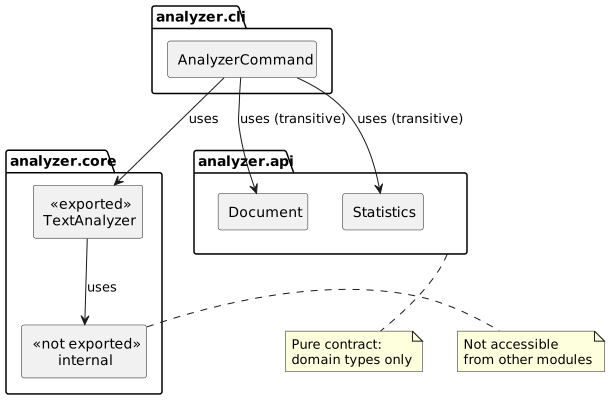
The project now has three Java modules:
- analyzer.api
Pure contract — domain types, no dependencies - analyzer.core
Implementation — depends on API transitively, provides service classes - analyzer.cli
Consumer — depends on core, gains access to API types automatically viarequires transitive
The contract module
The new module contains the domain records Document and Statistics, moved from core.model.
Module descriptor
module com.openelements.showcases.analyzer.api {
    exports com.openelements.showcases.analyzer.api; // ①
}
- Single export — all API types live in one package
The API module has no dependencies. It is a pure contract that any module can depend on without pulling in implementation details.
The Document and Statistics types moved from com.openelements.showcases.analyzer.core.model to com.openelements.showcases.analyzer.api.
NOTE: In the first
and previous
articles, a separate DocumentReader class in the core module handled reading files from disk.
With the API/core split, DocumentReader remains in the core module — and any module that needs to read a Document from disk must depend on core.
This becomes a problem when consumers should depend only on the API.
The clean alternative — a DocumentReader interface in the API module with an implementation in core — would require its own service wiring and add complexity.
A pragmatic solution: move the file-reading logic into Document itself as factory methods.
The Document record gains fromPath(Path) for the common UTF-8 case, and fromPath(Path, Charset) for reading with a specific character encoding.
    /**
     * Reads a document from the given path using UTF-8 encoding.
     *
     * @param path the path to the file
     * @return a new Document instance
     * @throws IOException if the file cannot be read
     */
    public static Document fromPath(Path path) throws IOException {
        return fromPath(path, StandardCharsets.UTF_8);
    }
    /**
     * Reads a document from the given path using the specified charset.
     *
     * @param path the path to the file
     * @param charset the charset to use for reading
     * @return a new Document instance
     * @throws IOException if the file cannot be read
     */
    public static Document fromPath(Path path, Charset charset) throws IOException {
        if (!Files.exists(path)) {
            throw new IOException("File not found: " + path);
        }
        if (!Files.isRegularFile(path)) {
            throw new IOException("Not a regular file: " + path);
        }
        String content = Files.readString(path, charset);
        return new Document(path, content);
    }
This keeps the API module self-contained without introducing additional classes or service interfaces.
One trade-off: the old DocumentReader logged file paths via Log4j before and after reading.
The API module has no logging dependency, so these diagnostic messages are gone.
Callers that need logging can add it at the call site.
The updated core module
The core module now uses the API types rather than defining them.
Module descriptor
module com.openelements.showcases.analyzer.core {
    requires transitive com.openelements.showcases.analyzer.api; // ①
    requires org.apache.logging.log4j; // ②

    exports com.openelements.showcases.analyzer.core.service; // ③
    // Note: com.openelements.showcases.analyzer.core.internal is NOT exported // ④
}
requires transitive— any module that requirescoreautomatically readsapi- Log4j is an implementation detail, required but not transitive
- Only the service package is exported
- The internal package remains encapsulated
The key change is requires transitive com.openelements.showcases.analyzer.api.
This means the API types appear in core’s exported signatures — TextAnalyzer.analyze(Document) returns Statistics — so consumers of core automatically need access to the API module.
The transitive keyword makes this explicit and automatic.
The TextAnalyzer class itself is unchanged — it still delegates to the internal TextNormalizer encapsulated in the previous article
.
Only its imports changed from core.model.Document to api.Document, and likewise for Statistics.
How requires transitive works
The command-line module’s descriptor has not changed from the previous article :
module com.openelements.showcases.analyzer.cli {
    requires com.openelements.showcases.analyzer.core;
    requires info.picocli;
    requires org.apache.logging.log4j;

    opens com.openelements.showcases.analyzer.cli to info.picocli;
}
The command-line module declares requires com.openelements.showcases.analyzer.core — and because core declares requires transitive com.openelements.showcases.analyzer.api, it can use Document and Statistics without an explicit requires api directive.
This is called implied readability: the transitive keyword propagates the dependency through the module graph.
Without transitive, the command-line module would need to declare:
module com.openelements.showcases.analyzer.cli {
    requires com.openelements.showcases.analyzer.core;
    requires com.openelements.showcases.analyzer.api; // ①
    requires info.picocli;
    requires org.apache.logging.log4j;

    opens com.openelements.showcases.analyzer.cli to info.picocli;
}
- Would be required without
transitiveon core’s dependency
What breaks without transitive?
If you remove the transitive keyword from core’s module-info.java:
module com.openelements.showcases.analyzer.core {
    requires com.openelements.showcases.analyzer.api; // no transitive!
    // ...
}
The command-line module will fail to compile:
error: package com.openelements.showcases.analyzer.api is not visible
  (package com.openelements.showcases.analyzer.api is declared in module
    com.openelements.showcases.analyzer.api, which is not in the module graph)
The compiler tells you exactly what’s wrong: the API module is not in the command-line module’s graph because core no longer transitively exports it.
The updated project structure
With three modules, the directory structure looks like this:
src/
├── com.openelements.showcases.analyzer.api/          ①
│   └── main/java/
│       ├── module-info.java
│       └── com/openelements/showcases/analyzer/api/
│           ├── Document.java
│           └── Statistics.java
├── com.openelements.showcases.analyzer.core/         ②
│   └── main/java/
│       ├── module-info.java
│       └── com/openelements/showcases/analyzer/core/
│           ├── internal/
│           │   └── TextNormalizer.java
│           └── service/
│               └── TextAnalyzer.java
└── com.openelements.showcases.analyzer.cli/          ③
    └── main/java/
        ├── module-info.java
        └── com/openelements/showcases/analyzer/cli/
            └── AnalyzerCommand.java
- API module — domain types, no dependencies
- Core module — implementation, depends on API transitively
- Command-line module — consumer, unchanged module descriptor
Updated POM configuration
The Maven POM now declares three module sources:
        <sources>
            <source>
                <module>com.openelements.showcases.analyzer.api</module> <!--1-->
            </source>
            <source>
                <module>com.openelements.showcases.analyzer.core</module> <!--2-->
            </source>
            <source>
                <module>com.openelements.showcases.analyzer.cli</module> <!--3-->
            </source>
        </sources>
- The API module — domain types
- The core module — implementation
- The command-line module
Maven compiles them in dependency order: api first — no dependencies — then core — depends on api — then cli — depends on core.
Source Code
The above changes are committed to the sample source code repository on GitHub
.
Clone it and switch to branch blog-3-api-impl:
git clone https://github.com/support-and-care/maven-modular-sources-showcases # unless already done
cd maven-modular-sources-showcases
git checkout blog-3-api-impl
Building and running
As described in the first article , compile and prepare the dependencies:
./mvnw prepare-package
Then run the application:
java --module-path "target/classes:target/lib" \
     --module com.openelements.showcases.analyzer.cli/com.openelements.showcases.analyzer.cli.AnalyzerCommand \
     README.*
The output is unchanged from the previous article — the API extraction is an internal restructuring that does not affect runtime behavior.
Summary
This article covered:
- How to separate domain types into a dedicated API module
- The
requires transitivedirective provides implied readability — consumers of core automatically get access to API types - Domain types (
Document,Statistics) belong in the API module — along with file-reading logic viaDocument.fromPath() - Service classes (
TextAnalyzer) remain in the core module - The command-line module’s descriptor is unchanged —
requires transitivehandles the wiring
This separation brings a clear architectural benefit: any future module can depend on just the API without pulling in the implementation.
However, you may have noticed that the command-line module still directly depends on the core module to instantiate TextAnalyzer.
The next article addresses this by introducing the Service Provider Interface pattern.
Using uses, provides, and ServiceLoader, the command-line module will depend only on the API module — achieving true inversion of control where the consumer no longer needs to know the implementation at all.
Homework
- Remove
transitiveand fix the build
Remove thetransitivekeyword from core’srequires apideclaration and observe the compilation error. Then add an explicitrequires com.openelements.showcases.analyzer.api;to the command-line module to fix it. Which approach do you prefer, and why? - Add a second consumer module
Create a test module that imports onlyDocumentandStatisticsfrom the API. Does it need to depend on core? What happens if it does — does it also get access toTextAnalyzer? - Preview: Inversion of Control
Right now the command-line module still instantiatesnew TextAnalyzer(...)directly, coupling it to the implementation. Can you imagine a way to discover the analyzer at runtime so the command-line module only needsrequires api? The next article explores this withServiceLoader.
Apache Maven and Maven are trademarks of the Apache Software Foundation .

Gerd Aschemann
Gerd brings years of intensive experience as a software architect with a strong development and operations background (DevOps). His particular strength lies in guiding his team and the organizations of his clients toward new technologies and approaches, and establishing new methods on a long-term basis.